My composition is based on a more rave and kind of eerie style. The basic structure I have it follow is an intro where we bring in different elements, a breakdown, where everything goes silent and only a synth remains, that is followed by a little buildup and dropping everything back in. After letting that play for a while , each element is removed until all sounds are gone. The visuals based on different variations of the voronoi effect with different parameters being changed by the midi notes throughout the composition. I utilized darker and more muted colors as i thought it fit with the eerie vibe of the composition more. When the beat drops, a oscillator is applied over the original voronoi with some additional parameters that results in a sort of glitchy effect where there are pauses between the showing of the visual.
I found it most interesting about his work flow that he doesn’t stick to one singular program or hardware. He doesn’t tie himself down to a particular workflow, but instead just tries whatever he enjoys. This idea I thought was very unusual since artists typically choose a software and get familiar with it but may often run into the risk of the technology being left behind. With his approach, he is always able to create no matter what is provided. Another interesting part was that he considers his work as “time design”. His work for syn_ allows for lengthening or shortening all depending on what is allowed for him, which is not something that is typically done for visual/ audio works. Another concept that really stuck with me is his process of “denaturing” where he isn’t trying to replicate things from the real world, but instead trying to break things down into data and attempting to reconstruct it in a way that reveals the underlying structures.
Sonic Pi was created by Sam Aaron, a programmer and live coding artist that developed it as his post-doc research at the University of Cambridge. He created the platform in hopes of making programming more accessible to children. It was developed in junction with the Raspberry Pi Foundation, as a easy to run program that could run on weaker computers, such as the Raspberry Pi.
It began as just an educational tool but evolved into a platform that is utilized both for learning, and for performing. This design is one of the things that I thought was different about Sonic Pi, it was developed for a range of users, meaning its features must be simple enough for children to operate, but also technical enough for live coding artists.
The program is easy to run, as the only software needed to download is the Sonic Pi software itself. The above mentioned philosophy for its feature set is also why there are built in tutorials within the software.
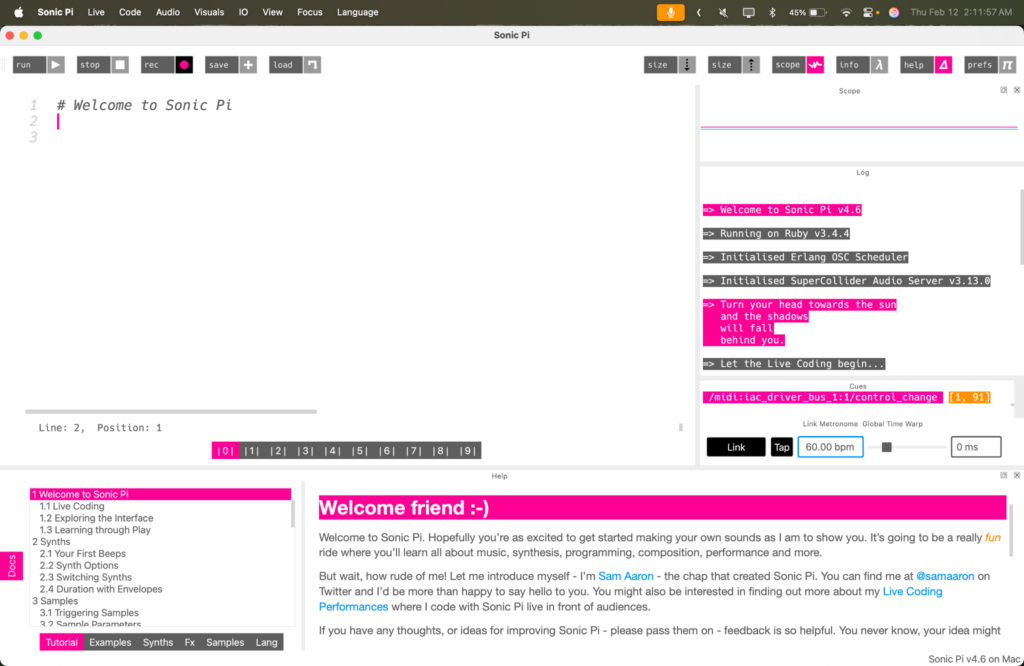
The Program runs similarly to how Tidal-Cycles does, where you type code and evaluate it. However, one core difference between Sonic Pi and Tidal-Cycles, is, instead of evaluating line by line, each time you run the code, you run the whole code on the current document. Similarly to Tidal-Cycles though, it doesn’t generate any sound itself, but it utilizes SuperCollider for sound generation, albeit, having it built into the program when you download it.
The reading further how I believed in how percussion in music is able to drive so much emotion, even without the usage of words. One thing I have noticed however within electronic music especially is the prevalence of technology and ease of having percussion always be perfectly on time. Although this makes a song sound “perfect” it has no character, it lacks the emotions that were able to be conveyed through a traditional drumkit. The “funk” of drumming is gone. However, with the improvements in technology, there are so many effects that could be used artistically by different artists that I believe is able to express themselves in different ways and evoke different emotions within the listeners. One genre in specifically I believe that captures this usage of both technology while keeping the sound and emotions of drummers is jungle. Utilizing sampled drum breaks, they are able to utilize technology to alter the drum breaks, sequencing them in their own artistic way, all while keep the original swing and groove to it.
One key thing that stood out to me from this reading was where it said that live coding could be best characterized as “thinking in public”. I believe this is something that is lacking from majority of types of musical performances. You see an orchestra on stage, the thinking they’re doing is practically just following along with the music that they have practiced for months. Seeing a DJ on stage, they are playing pre-existing songs, and even when they are doing something live, you have no idea what they are doing. Live coding on the other hand shows everyone in the audience what you are doing, changing the code with the visuals and sounds reflecting it. Your thought process is being shown to the audience through your code, and that’s what makes it unique and different. Through live coding, you are embracing the fact that your computer is being utilized, instead of it being an invisible tool.