my practice sessions for this week!
What I found most interesting in the reading is not just the claim that glitches reveal hidden structures, but the way it almost romanticizes breakdown as something inherently meaningful. I get why that’s appealing, especially when most of our interactions with technology are designed to feel seamless and unquestionable. But I’m not fully convinced that every disruption actually produces insight. Sometimes a glitch just feels like noise in the most literal sense, frustrating and empty rather than revealing. I think the manifesto leans heavily into the idea that opacity is always more honest than transparency, but I wonder if that’s just flipping one bias for another. There’s still a kind of aesthetic preference being imposed, where breakdown is treated as more authentic than functionality, and I’m not sure that always holds up outside of an artistic context.
At the same time, I did find the idea of glitches losing their meaning once they are recognized or reproduced much more convincing, because it points to something broader about how culture works. The moment something becomes legible, it becomes easier to package, repeat, and eventually normalize. That tension between the accidental and the intentional felt like the strongest part of the text for me, especially because it doesn’t fully resolve it. If a glitch only matters in the moment before it is understood, then any attempt to study or recreate it is already too late. That makes glitch art feel almost self-defeating, but also strangely honest about its own limits. I also liked that the manifesto doesn’t treat technology as neutral, but I think it sometimes overstates how much agency we gain through disruption. Not every break in a system leads to awareness or critique. Still, it made me think more carefully about how much I rely on smoothness and predictability, and how rarely I question what gets hidden in the process of making things “just work.”
This project explores a journey through different emotional and cultural states, inspired by the progression of a day and the feeling of returning home. I structured the composition as four distinct sections: Subah (morning), Dhak (rhythm and movement), Toofaan (chaos), and Ghar (homecoming). Each section combines both audio and visuals to reflect a specific mood — from the softness of sunrise to the intensity of a storm, and finally to a calmer, resolved ending.
I spent a lot of time experimenting with how to connect TidalCycles and Hydra through MIDI so that the visuals would respond meaningfully to the music. The hardest part was getting everything to sync and behave consistently took multiple attempts and debugging sessions. I also iterated a lot on the visuals, trying to move away from repetitive patterns and instead create distinct visual identities for each section. The final result is something that feels cohesive but still varied, where both the audio and visuals evolve together as the piece progresses.
Tidal code
setcps (85/60/4)

silence_all = do
  d1 silence
  d2 silence
  d3 silence
  d4 silence
  d5 silence
  d6 silence
  d7 silence
  d8 silence
  d9 silence

subah = do
  -- scene select: 0 = SUBAH
  d1 $ n "0*8" # s "midi" # midichan 0 # ccn 0 # ccv "0"


  d2 $ n "0*16" # s "midi" # midichan 0 # ccn 1 # ccv (range 0 45 $ slow 12 sine)
  d8 $ n "0*16" # s "midi" # midichan 0 # ccn 2 # ccv (range 10 50 $ slow 16 sine)

  d3 $ slow 4 $ s "sitar" # n "<0 5 3 7>"
    # room 0.95 # gain 0.75 # speed 0.8
    # lpf 2200 # pan (slow 5 sine) # cut 1

  d4 $ slow 4 $ s "supersaw"
    # note "c4 e4"
    # sustain 4 # gain 0.35 # lpf 600 # room 0.9 # lpq 0.12

  d5 $ struct "t(3,16)" $ slow 2 $ s "tabla2"
    # n (irand 46) # room 0.85 # gain 0.6
    # speed (range 0.85 1.15 rand)

  d6 silence
  d7 silence


dhak = do
  d1 $ n "1*8" # s "midi" # midichan 0 # ccn 0 # ccv "1"

  d9 $ n "0*4" # s "midi" # midichan 0 # ccn 3 # ccv "<0 64 0 64>"

  -- hydra motion
  d2 $ n "0*16" # s "midi" # midichan 0 # ccn 1 # ccv (range 20 85 $ slow 4 saw)
  d8 $ n "0*16" # s "midi" # midichan 0 # ccn 2 # ccv (range 20 90 $ slow 8 sine)

  d3 $ stack [
    s "tabla2*8"
      # n "<[20 8 8 20 20 8 3 12] [20 8 3 20 20 3 8 12]>"
      # room 0.5 # gain (range 0.95 1.1 rand),
    s "tabla:0(3,8)" # room 0.4 # gain 1.05 # speed 0.8,
    s "~ cp" # room 0.6 # gain 0.9
    ]

  d4 $ sometimesBy 0.25 (# speed 2)
    $ every 4 rev
    $ s "pluck"
    # note "<c5 e5 g5 e5 a5 g5 e5 d5>"
    # room 0.55 # gain 0.85 # speed 1.5

  d5 $ slow 2 $ s "supersaw"
    # note "<c3 e3 c3 d3>"
    # sustain 1.5 # gain 0.4 # lpf 550 # room 0.75

  d6 $ struct "t(1,8)" $ s "sitar"
    # n (irand 8) # room 0.65 # gain 0.7 # cut 1

  d7 silence


toofaan = do
  d1 $ n "2*8" # s "midi" # midichan 0 # ccn 0 # ccv "2"

  d9 $ n "0*8" # s "midi" # midichan 0 # ccn 3 # ccv "<0 64 100 64 0 100 64 0>"

  d2 $ n "0*16" # s "midi" # midichan 0 # ccn 1 # ccv (range 45 127 $ slow 2 saw)
  d8 $ n "0*16" # s "midi" # midichan 0 # ccn 2 # ccv (range 30 127 $ slow 4 saw)

  d3 $ s "[808bd:4(5,8), ~ 808:3, ~ cp ~ cp]"
    # room 0.6 # krush 7
    # speed (slow 4 "<1.5 1>") # gain 1.15

  d4 $ rotL 1 $ every 4 (fast 2)
    $ s "tabla2*8"
    # n "<[20 6 6 20 8 6 3 12] [20 3 6 20 8 12 6 3]>"
    # room 0.3 # gain 1.05
    # speed (range 0.95 1.15 rand)

  d5 $ fast 2 $ s "supersaw"
    # note "<c5 e5 g5 a5 g5 e5 d5 c5>"
    # sustain 0.12 # gain 0.5 # room 0.35
    # lpf (slow 4 $ range 1000 7000 saw) # lpq 0.25

  d6 $ slow 2 $ s "moog:2"
    # note "<c4 d#4 e4 c4>"
    # legato 1 # gain 0.6
    # lpf (segment 1000 $ slow 4 $ range 200 2200 saw) # lpq 0.3

  d7 $ fast 2 $ s "hh*2 hh*2 hh*2 <hh*6 [hh*2]!3>"
    # room 0.4 # gain (range 0.9 1.1 rand)


    ghar = do
      d1 $ n "3*8" # s "midi" # midichan 0 # ccn 0 # ccv "3"

      d9 $ n "0*4" # s "midi" # midichan 0 # ccn 3 # ccv "<0 64 0 64>"

      d2 $ n "0*16"
        # s "midi"
        # midichan 0
        # ccn 1
        # ccv (range 28 4 $ slow 16 sine)

      d8 $ n "0*16"
        # s "midi"
        # midichan 0
        # ccn 2
        # ccv (range 30 6 $ slow 16 sine)

      d3 $ slow 2 $ s "sitar"
        # n "<0 2 4 7 7 4 2 0>"
        # gain 0.9
        # room 0.95
        # speed 0.82
        # lpf 1800
        # cut 1

      d4 $ slow 4 $ s "pluck"
        # n "<4 ~ 2 ~ 0 ~ -2 ~>"
        # gain 0.38
        # room 0.9
        # sustain 0.4
        # lpf 1500

      d5 $ slow 4 $ s "supersaw"
        # note "c4 e4"
        # sustain 5
        # gain 0.16
        # room 0.98
        # lpf 320
        # lpq 0.15

      d6 $ struct "t(2,16)" $ s "tabla2"
        # n "<20 8>"
        # gain 0.38
        # room 0.8
        # lpf 1400

      d7 $ struct "t(1,16)" $ s "pluck"
        # n "<7 4>"
        # gain 0.14
        # room 0.95
        # sustain 0.25
        # lpf 2200


 subah
dhak
toofaan
ghar


hush
hydra code
window.cc = Array(128).fill(0)
window.ccActual = Array(128).fill(0)

navigator.requestMIDIAccess().then(function(access) {
  var inputs = Array.from(access.inputs.values())
  var input = inputs.find(i => i.name && i.name.indexOf("IAC") !== -1) || inputs[0]

  if (!input) { window.hydraText = "No MIDI input found"; return }
  window.hydraText = "MIDI: " + input.name

  input.onmidimessage = function(msg) {
    var status = msg.data[0]
    var ctrl   = msg.data[1]
    var val    = msg.data[2]
    window.hydraText = "cc" + ctrl + " → " + val
    if (status === 176) {
      cc[ctrl] = val / 127
      if (ctrl === 0) ccActual[0] = Math.min(3, Math.floor(val / 32))
      if (ctrl === 3) ccActual[3] = Math.min(2, Math.floor(val / 43))
    }
  }
})

window.DD = 0.008
window.c = (u, i, j) => {
  let segs = u.split("/"), cs = segs[segs.length - 1].split("-")
  return parseInt("0x" + cs[i].substring(2 * j, 2 + 2 * j)) / 255
}
window.b = (o, u, i, y, z) =>
  o().add(solid(1,1,1), DD)
    .thresh(i * 0.2 * (z - y) + y, 0.0001)
    .luma(0.5, 0.0001)
    .color(c(u,i,0), c(u,i,1), c(u,i,2))

window.colorize = (x, u, y=0, z=1) =>
  b(x,u,0,y,z).layer(b(x,u,1,y,z)).layer(b(x,u,2,y,z))
               .layer(b(x,u,3,y,z)).layer(b(x,u,4,y,z))

window.asp = () => innerHeight / innerWidth

window.madhubaniP = 'https://coolors.co/1b3fa6-c0341f-e8b832-2d6e2d-1a1a1a'
window.pichwaiP   = 'https://coolors.co/0d5c63-e87ca0-f0c040-fdf6e3-1b4f8a'
window.mughalP    = 'https://coolors.co/1b3d8f-c0251a-d4a017-f5f0e8-4a2c10'
window.toofaanP   = 'https://coolors.co/e0105f-ff6b00-ffe000-00d4aa-7b00e0'
window.gharP      = 'https://coolors.co/c0522a-d4803a-e8b060-f5dfc0-3d2b1f'

hush()

window.subah_A = () => {
  let hatch = () =>
    osc(60, 0.008, 0.5)
      .rotate(Math.PI / 4)
      .diff(osc(60, 0.008, 0.5).rotate(-Math.PI / 4))
      .kaleid(4)
      .scale(1, asp)

  let fishBody = () =>
    voronoi(6, 0.25, 0.1)
      .diff(voronoi(12, 0.2, 0.08))
      .kaleid(4)
      .rotate(0, () => 0.003 + cc[1] * 0.005)
      .scale(1, asp)

  colorize(() => fishBody(), madhubaniP, 0, 1)
    .layer(
      colorize(() => hatch(), madhubaniP, 0.2, 0.7)
        .luma(() => 0.5 - cc[1] * 0.1, 0.005)
    )
    .modulate(
      noise(() => cc[1] * 1.2 + 0.4, 0.015),
      () => cc[1] * 0.025 + 0.005
    )
    .saturate(() => 2.0 + cc[2] * 1.0)
    .contrast(() => 1.4 + cc[2] * 0.4)
    .hue(() => cc[2] * 0.08)
    .brightness(() => cc[1] * 0.04 - 0.01)
    .out(o0)
}

window.subah_B = () => {
  let petal = () =>
    osc(20, 0.02, 1.2)
      .mult(osc(20, 0.02, 1.2).rotate(Math.PI / 8))
      .kaleid(8)
      .rotate(0, () => 0.002 + cc[1] * 0.004)
      .scale(0.9, asp)

  let outerBuds = () =>
    osc(40, 0.01, 0.8)
      .mult(osc(40, 0.01, 0.8).rotate(Math.PI / 16))
      .kaleid(16)
      .rotate(0, () => -0.001 - cc[1] * 0.002)
      .scale(1, asp)

  colorize(() => petal(), pichwaiP, 0, 1).out(o1)
  colorize(() => outerBuds(), pichwaiP, 0.15, 0.85).out(o2)

  src(o1)
    .layer(src(o2).luma(0.4, 0.01))
    .add(src(o0).scale(0.998).brightness(-0.015), () => 0.08 + cc[2] * 0.12)
    .hue(() => cc[2] * 0.05 + time * 0.002)
    .saturate(() => 1.6 + cc[2] * 0.8)
    .contrast(() => 1.2 + cc[1] * 0.2)
    .out(o0)
}

window.dhak_A = () => {
  let stars = () =>
    osc(22, 0.04, 1.4)
      .rotate(Math.PI / 6, () => 0.01 + cc[1] * 0.02)
      .mult(osc(22, 0.04, 1.4).rotate(-Math.PI / 6, () => -0.01 - cc[1] * 0.015))
      .diff(osc(44, 0.02, 0.6).rotate(Math.PI / 12))
      .kaleid(12)
      .scale(1, asp)

  let inlay = () =>
    osc(66, 0.01, 0.4)
      .rotate(Math.PI / 4, () => 0.005 + cc[1] * 0.008)
      .kaleid(12)
      .scale(1.05, asp)

  colorize(() => stars(), mughalP, 0, 1)
    .layer(
      colorize(() => inlay(), mughalP, 0.3, 0.9)
        .luma(() => 0.45 + cc[2] * 0.15, 0.005)
    )
    .modulateRotate(
      osc(4, 0.02, 0),
      () => cc[1] * 0.3 + 0.02
    )
    .hue(() => time * 0.004 + cc[2] * 0.06)
    .saturate(() => 1.8 + cc[2] * 0.7)
    .contrast(() => 1.35 + cc[1] * 0.35)
    .out(o0)
}

window.dhak_B = () => {
  let vine = () =>
    noise(() => cc[1] * 2 + 1.5, 0.025)
      .mult(
        osc(12, 0.03, 1)
          .rotate(0, () => 0.008 + cc[1] * 0.01)
          .kaleid(6)
      )
      .scale(1, asp)

  let veins = () =>
    osc(50, 0.006, 0.6)
      .rotate(Math.PI / 3)
      .diff(osc(50, 0.006, 0.6).rotate(-Math.PI / 3))
      .kaleid(6)
      .rotate(0, () => 0.004 + cc[1] * 0.006)
      .scale(1, asp)

  colorize(() => vine(), madhubaniP, 0, 1)
    .layer(
      colorize(() => veins(), madhubaniP, 0.25, 0.75)
        .luma(() => 0.4 + cc[2] * 0.2, 0.005)
    )
    .modulate(noise(2, 0.02), () => cc[1] * 0.03 + 0.008)
    .hue(() => cc[2] * 0.1 + time * 0.003)
    .saturate(() => 2.2 + cc[2] * 0.8)
    .contrast(() => 1.3 + cc[1] * 0.3)
    .brightness(() => cc[1] * 0.05 - 0.02)
    .out(o0)
}

window.toofaan_A = () => {
  let yantra = () =>
    osc(28, 0.04, 2)
      .rotate(0, () => 0.025 + cc[1] * 0.04)
      .diff(
        osc(28, 0.04, 2)
          .rotate(Math.PI / 3, () => -0.025 - cc[1] * 0.03)
      )
      .kaleid(() => Math.floor(cc[1] * 10 + 3))
      .scale(1, asp)

  src(o0)
    .layer(
      colorize(() => yantra(), toofaanP, 0, 1)
        .luma(() => 0.3 - cc[1] * 0.1, 0.01)
    )
    .modulate(
      noise(() => cc[1] * 5 + 2, 0.04),
      () => cc[1] * 0.07 + 0.005
    )
    .scale(0.996)
    .rotate(0, () => cc[1] * 0.004)
    .colorama(() => cc[2] * 0.1 + 0.004)
    .hue(() => cc[2] * 0.03 + time * 0.006)
    .saturate(() => 1.8 + cc[2] * 1.2)
    .contrast(() => 1.3 + cc[1] * 0.4)
    .out(o0)
}

window.toofaan_B = () => {
  let powder = () =>
    noise(() => cc[1] * 10 + 4, 0.08)
      .mult(osc(40, 0.03, 2).kaleid(8))
      .pixelate(() => 8 + cc[1] * 300, () => 8 + cc[1] * 300)
      .scale(1, asp)

  let arcs = () =>
    osc(55, 0.025, 1.8)
      .rotate(0, () => 0.03 + cc[1] * 0.05)
      .kaleid(6)
      .pixelate(() => 32 + cc[2] * 150, 32)
      .scale(1, asp)

  colorize(() => powder(), toofaanP, 0, 1)
    .layer(
      colorize(() => arcs(), toofaanP, 0.1, 0.9)
        .luma(() => 0.4 - cc[1] * 0.15, 0.01)
    )
    .colorama(() => cc[2] * 0.15 + 0.005)
    .hue(() => cc[2] * 0.05 + time * 0.008)
    .saturate(() => 2.0 + cc[1] * 0.8)
    .contrast(1.25)
    .out(o0)
}

window.toofaan_C = () => {
  let tiles = () =>
    osc(32, 0.05, 1.6)
      .rotate(Math.PI / 8, () => 0.02 + cc[1] * 0.04)
      .mult(osc(32, 0.05, 1.6).rotate(-Math.PI / 8, () => -0.015 - cc[1] * 0.03))
      .kaleid(8)
      .scale(1, asp)

  src(o0)
    .layer(
      colorize(() => tiles(), mughalP, 0, 1)
        .luma(() => 0.35 - cc[1] * 0.1, 0.01)
    )
    .modulatePixelate(
      noise(() => cc[1] * 6 + 2, 0.05).pixelate(16, 16),
      () => cc[1] * 768 + 8
    )
    .scale(() => 0.994 + cc[1] * 0.006)
    .rotate(0, () => cc[1] * 0.005)
    .colorama(() => cc[2] * 0.06 + 0.002)
    .hue(() => time * 0.005 + cc[2] * 0.04)
    .saturate(() => 1.6 + cc[2] * 0.8)
    .contrast(() => 1.2 + cc[1] * 0.3)
    .out(o0)
}

window.ghar_A = () => {
  let petal = () =>
    osc(14, 0.015, 1.0)
      .mult(osc(14, 0.015, 1.0).rotate(Math.PI / 8))
      .kaleid(8)
      .rotate(0, () => 0.001 + cc[1] * 0.002)
      .scale(0.85, asp)

  let water = () =>
    voronoi(3, 0.05, 0.3)
      .diff(voronoi(6, 0.04, 0.25))
      .scrollY(() => time * 0.003)
      .scale(1, asp)

  colorize(() => water(), pichwaiP, 0, 0.8)
    .layer(
      colorize(() => petal(), pichwaiP, 0.1, 0.75)
        .luma(() => 0.25 + cc[1] * 0.15, 0.02)
    )
    .add(
      src(o0).scale(0.999).brightness(-0.025),
      () => 0.15 + cc[2] * 0.12
    )
    .hue(() => cc[2] * 0.04 + 0.001)
    .saturate(() => 1.2 + cc[2] * 0.5)
    .brightness(() => -0.04 + cc[1] * 0.04)
    .contrast(1.1)
    .out(o0)
}

window.ghar_B = () => {
  let warli = () =>
    shape(3, 0.55, 0.01)
      .scale(1, asp)
      .kaleid(6)
      .rotate(0, () => 0.003 + cc[1] * 0.005)
      .mult(
        osc(8, 0.015, 0.5)
          .kaleid(6)
          .rotate(Math.PI / 6, () => -0.002 - cc[1] * 0.003)
      )

  let alpana = () =>
    voronoi(4, 0.08, 0.18)
      .diff(voronoi(9, 0.07, 0.14))
      .scrollY(() => time * 0.004)
      .scale(1, asp)

  colorize(() => alpana(), gharP, 0, 1)
    .layer(
      colorize(() => warli(), gharP, 0.1, 0.7)
        .luma(() => 0.22 + cc[1] * 0.18, 0.02)
    )
    .modulateRotate(noise(1.5, 0.012), () => cc[1] * 0.035 + 0.003)
    .add(src(o0).scale(0.999).brightness(-0.018), () => 0.1 + cc[2] * 0.1)
    .hue(() => cc[2] * 0.05 + 0.001)
    .saturate(() => 1.1 + cc[2] * 0.4)
    .brightness(() => -0.03 + cc[1] * 0.04)
    .contrast(1.12)
    .out(o0)
}

window.launchSubah = () => {
  hush()
  var v = ccActual[3] || 0
  if (v === 0) subah_A()
  else         subah_B()
}

window.launchDhak = () => {
  hush()
  var v = ccActual[3] || 0
  if (v === 0) dhak_A()
  else         dhak_B()
}

window.launchToofaan = () => {
  hush()
  var v = ccActual[3] || 0
  if      (v === 0) toofaan_A()
  else if (v === 1) toofaan_B()
  else              toofaan_C()
}

window.launchGhar = () => {
  hush()
  var v = ccActual[3] || 0
  if (v === 0) ghar_A()
  else         ghar_B()
}

window.whichScene  = 0
window.whichSub    = 0

launchSubah()

update = () => {
  var nextScene = Math.max(0, Math.min(3, ccActual[0]))
  var nextSub   = Math.max(0, Math.min(2, ccActual[3]))

  if (window.whichScene !== nextScene || window.whichSub !== nextSub) {
    window.whichScene = nextScene
    window.whichSub   = nextSub
    switch (nextScene) {
      case 0: launchSubah();   break
      case 1: launchDhak();    break
      case 2: launchToofaan(); break
      case 3: launchGhar();    break
    }
  }
}What stood out to me most in this reading on Ryoichi Kurokawa is how seriously it takes the idea of scale, not just in a visual sense but in how we experience and process it as viewers. The text moves between the cosmic and the microscopic, from distant stars to butterfly wings, and what feels important is that this movement is not meant to be symbolic or poetic. It is structural. Kurokawa’s work is not really about representing nature as we know it, but about breaking it apart, abstracting it, and rebuilding it through sound and image until it feels unfamiliar, intense, and slightly disorienting.
I was especially drawn to the way the reading describes his process and studio environment. Everything feels extremely controlled, technical, and precise, yet the outcomes are often chaotic, dense, and overwhelming. That contrast feels very intentional. Natural phenomena are described as being “de-natured” and translated into data, rhythms, and visual noise, which really stood out to me. Rather than suggesting that technology gives us clearer access to nature, Kurokawa seems to argue the opposite. Our experience of the natural world is always filtered through systems, tools, and mediation, and his work makes that fragmentation visible instead of hiding it.
The idea that his works are never fixed also stayed with me. His performances and installations change depending on the space, scale, and context in which they are presented, which makes the work feel alive rather than finished. It challenges the idea of art as a stable object and instead treats it as a system that keeps shifting and evolving over time. I found that approach refreshing, especially when compared to more traditional forms that prioritize permanence and a single, final version of the work.
What ultimately stays with me is how little his work seems to care about comfort. Even when the visuals are beautiful, there is a constant sense of tension and pressure, especially through sound. The experience feels physical, almost confrontational at times, as if it is pushing against the limits of what the body and senses can handle. Rather than explaining the world or making it feel more legible, Kurokawa’s work disrupts it, pushing perception until it starts to feel fragile. That discomfort feels intentional and honest, and it is what makes the work linger long after the experience ends.
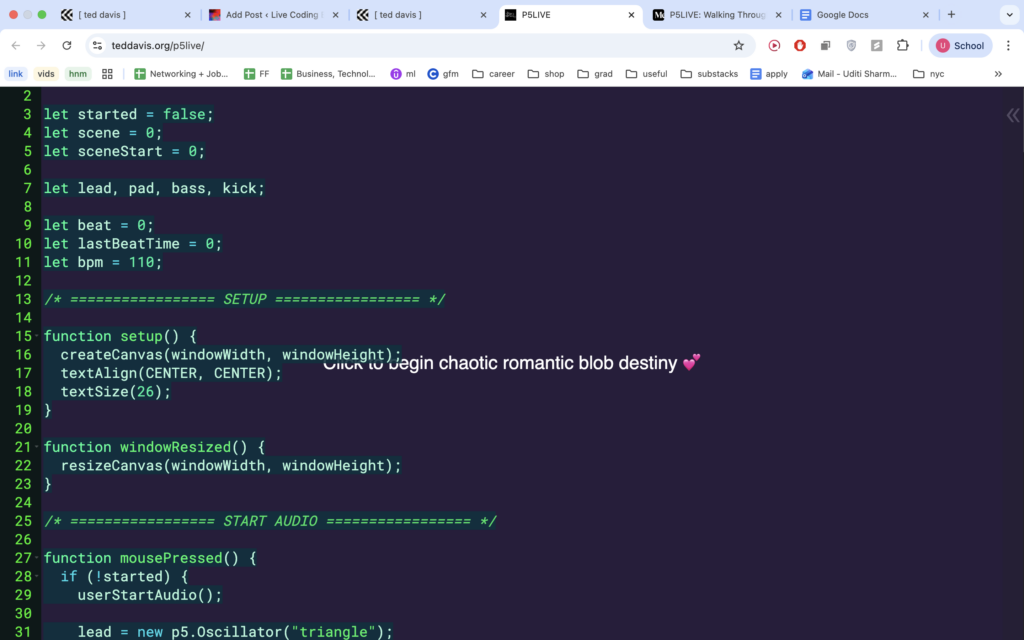
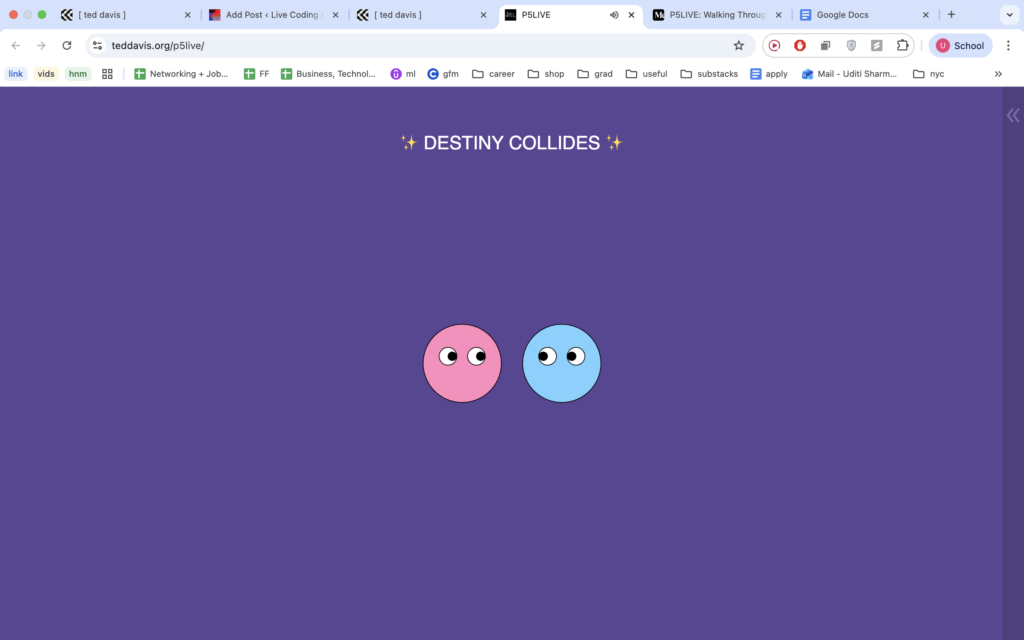
I researched P5LIVE, a collaborative live coding platform for p5.js that runs in the browser. Live coding is an art practice where the process is the performance. You write and change code in real time, and the visuals update immediately, often with the code visible too. P5LIVE was created by Ted Davis, a media artist and educator in Basel, originally for a Processing Community Day event where people wanted to live code visuals during a DJ party.
What I like about P5LIVE is that it treats live coding as a social activity. It lowers friction by running in the browser, and it makes collaboration feel natural through links and shared rooms. It is not just an editor. It is a space where teaching, performance, and experimentation overlap. Instead of coding being private and finished, P5LIVE encourages coding as something collective and ongoing.
P5LIVE’s key feature is COCODING, which works like Google Docs for code. You create a room link, others join, and everyone edits the same sketch together in real time while the visuals run locally for each person. It also includes classroom and performance features like lockdown mode, chat, and SyncData, which lets people share live inputs like MIDI or mouse data with the group. In my demo, I will show the instant feedback loop and a basic COCODING session.
What I found most interesting about this reading was how much weight it gives to really small things. Tiny timing shifts that are almost impossible to notice unless you are listening closely. The idea that a groove can feel expressive not because it changes dramatically, but because it is slightly off in very specific ways, made me rethink what “emotion” in music actually looks like
I also liked how the text treats musical communication as something that does not need to say anything clearly or directly. It feels more like people getting in sync with each other than sending messages back and forth. Groove becomes a shared sense of time, where musicians are constantly adjusting to one another and responding at a level that is felt more than understood
The discussion of microtiming and the body stood out to me too. A perfectly quantized beat can feel strange because it removes the trace of a human presence, but the reading also makes it clear that this absence can be intentional and meaningful. What matters is not whether a rhythm is human or electronic, but what kind of relationship it creates with the listener.
Overall, the piece made me more aware of how much expression lives in small imperfections, and how being slightly off can be what makes something feel alive in the first place