Rosa Menkman’s Glitch Studies Manifesto is an interesting read but it can feel overwritten at times. That said one argument genuinely stuck with me and it was the idea that a glitch is not just a mistake but a moment that exposes what a technology actually is beneath its polished surface. When something breaks you suddenly see the system and its assumptions and limits. I think that framing makes a lot of sense.
Working in TidalCycles and Hydra I think about this a lot. When Im live coding and something goes wrong like a pattern fires off rhythm or a Hydra function produces something completely unexpected there is this brief moment of panic but also genuine curiosity. Like what just happened and why did it do that? Menkman would probably call that the acousmatic quality of glitch where you are confronted with an output you cannot fully trace back to a source. In my project I was deliberately layering tabla samples with glitchy electronic sounds and the tension between those two things felt like exactly what she was describing. I feel like the interruption becomes the point.
Where Im less convinced is her claim that intentional glitch art still counts as true glitch. I think once you are designing the error you have already domesticated it. There is a real difference between a glitch that surprises you and one that you planned. The shock is what makes it what it is.
For this composition I created an audiovisual piece using TidalCycles for sound and Hydra for visuals.
The piece is structured into five sections:
intro
buildup
breakdown
beatdrop
outro
Each of them are triggered manually in Tidal by evaluating a named do block. The sound is built around tabla samples layered with glitch percussion, with each section adding or removing layers to create a sense of tension and release. The visual side was built in Hydra with four scenes that match each compositional section. I chose tabla specifically because I wanted to bring in a sound that felt personal and culturally grounded and pairing it with glitch electronics felt like an interesting contrast between something organic and something digital.
Composition Video:
Code Snippet:
setcps (130/60/4)

intro = do
 d1 $ slow 2 $ degradeBy 0.6 $ s "tabla" # n (irand 4) # gain 0.8 # room 0.95 # size 0.9 # speed 0.5
 d2 $ degradeBy 0.8 $ s "glitch" # crush 12 # gain 0.6 # pan rand
 d3 $ s "space" # gain 0.5 # room 0.5 # size 0.5 # speed 0.5
 d8 $ ccv 0 # ccn 0 # s "midi"

buildup = do
 d1 $ s "tabla*2" # n (irand 8) # gain 1.0 # room 0.6 # speed (choose [1, 1.5, 0.75])
 d2 $ whenmod 4 3 (stutter 2 0.25) $ s "glitch*4" # crush 8 # gain 0.75 # pan rand
 d3 $ every 4 (fast 2) $ s "tabla" # n (irand 8) # gain 0.9 # room 0.8 # speed 0.75
 d4 $ degradeBy 0.8 $ s "glitch" # crush 6 # gain 0.7 # speed (choose [1, 2])
 d8 $ ccv 42 # ccn 0 # s "midi"

breakdown = do
 d1 $ slow 2 $ degradeBy 0.4 $ s "tabla" # n (irand 4) # gain 1.1 # room 0.95 # size 0.9 # speed (choose [0.5, 0.75])
 d2 $ whenmod 8 7 (density 4) $ s "glitch*2" # crush 4 # gain 0.85 # pan rand
 d3 $ silence
 d4 $ every 2 (# speed 0.5) $ s "glitch" # crush 3 # gain 0.9 # room 0.7
 d8 $ ccv 84 # ccn 0 # s "midi"

beatdrop = do
 d1 $ s "tabla*4" # n (irand 16) # gain 1.3 # room 0.2 # size 0.3 # speed (choose [1, 1.5, 2, -1])
 d2 $ whenmod 4 3 (stutter 4 0.125) $ s "glitch*8" # gain 0.9 # crush 6 # speed (choose [1, 2, -1]) # pan rand
 d3 $ every 3 (fast 2) $ s "tabla" # n (irand 16) # gain 1.1 # room 0.9 # size 0.8 # speed (choose [0.5, 1, 2])
 d4 $ whenmod 8 7 (density 4) $ s "glitch" # crush 8 # gain 0.8 # pan rand
 d5 $ fast 2 $ s "tabla*2" # n (irand 8) # gain 1.2 # crush 5 # speed (choose [1, -1, 2])
 d8 $ ccv 127 # ccn 0 # s "midi"

outro = do
 d1 $ degradeBy 0.7 $ slow 2 $ s "tabla" # n (irand 4) # gain 0.7 # room 0.95 # size 0.9 # speed 0.5
 d2 $ degradeBy 0.8 $ s "glitch" # crush 12 # gain 0.5
 d3 $ s "space" # gain 0.4 # room 0.5 # size 0.5 # speed 0.5
 d4 $ silence
 d5 $ silence
 d8 $ ccv 0 # ccn 0 # s "midi"

stop_it = do
 d1 $ silence
 d2 $ silence
 d3 $ silence
 d4 $ silence
 d5 $ silence
 d8 $ silence

intro
buildup
breakdown
beatdrop
outro
stop_it
I think what I felt most while reading this was a quiet sense of awe. The description of Kurokawa’s Berlin studio immediately pulled me in. Black felt carpet, no internet and a doorbell that doesn’t work. It felt like reading about someone who has built a world specifically designed for focus. I could almost feel the muffled silence of that space.
I was especially struck by how patiently he works. He said, “Nature doesn’t change overnight; it evolves gradually over time. I like this approach and try to do the same.” Reading that, I felt a deep admiration for his dedication. In a world that pushes for speed and constant output, here is someone who lets projects take five years if they need to. He doesn’t chase new technology or cling to old media. He just stays inside his process.
The image of him standing alone on that taped X on the floor, the sweet spot where he tests everything, stayed with me. It felt like a portrait of someone completely surrendered to their craft. I think that’s what moved me most. Not the awards or the prestigious venues, but the sense that he has arranged his entire life around his work itself.
Alda is a text-based, open-source programming language designed for musicians to compose music in a text editor without needing complex graphical user interface (GUI) software.
The Alda music programming language was created by Dave Yarwood in 2012. Interestingly, he was a classically trained musician long before he was a competent programmer
Why Alda?
In contrast to working with complex GUI applications available at the time, Dave Yarwood found that programming pieces of music in a text editor is a pleasantly distraction-free experience.
How it Works
The process is beautifully simple:
Write the notes in a text file using Alda’s syntax
Run the file through the Alda interpreter
Hear the music come to life
Key Features
Alda uses the General MIDI sound set — giving you access to over 100 instruments.
Basic Syntax
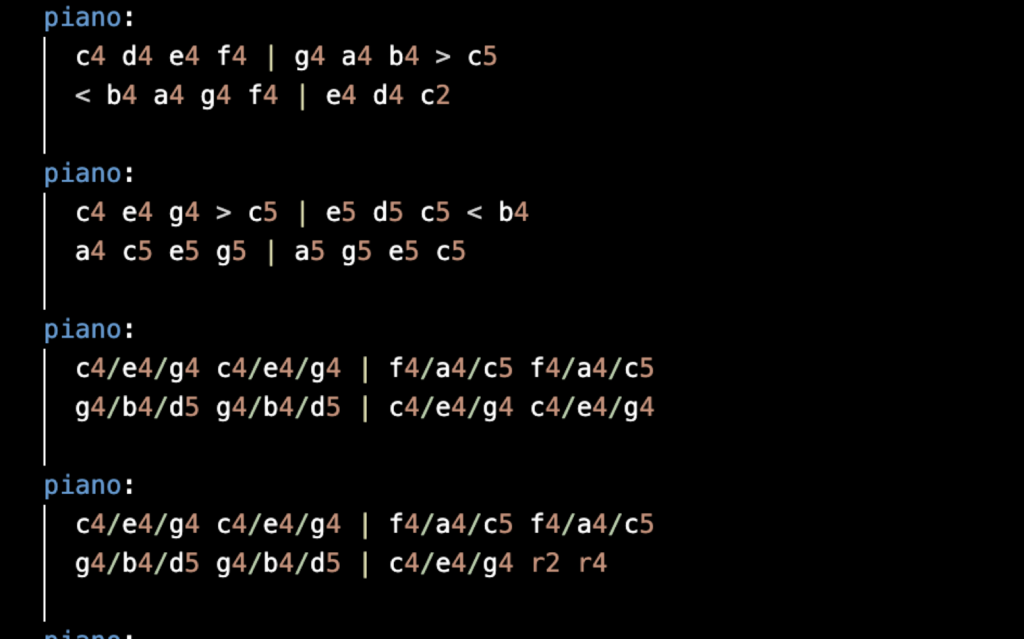
Pitch: The letter represents the pitch. c is C, d is D, e is E, and so on.
Duration: The number indicates how long it lasts in beats. In Alda, smaller numbers mean longer notes—it’s backwards from how we normally think!
Octave: The octave number tells Alda how high or low to play. c4 is middle C, c5 is one octave higher, c3 is one octave lower.
Handy Shortcuts
> moves you up one octave
< moves you down one octave
Chords and Rests
The forward slash / is your chord maker. It tells Alda to play notes at the exact same time.
Rests use r instead of a note name. The same duration rules apply.
Visual Aid
The vertical bar | does absolutely nothing to the sound. It’s just there to help you read the music more easily.
Alda represents a beautiful intersection between programming and musicianship—proof that sometimes the simplest tools can inspire the most creative work.
When I think about what music is saying, this passage makes it clear: it is not about words. I realized I have been looking for a hidden message when the real conversation is in how it makes you feel. The call and response in a song is not sharing information. It is sharing a moment.
The idea that this happens through microtiming was interesting to learn. Musicians are not just playing notes to each other. They are listening and answering in real time with their timing. That is the communication.
Music’s meaning is not something you decode. It is something you experience together, a connection built note by note. The conversation is the feelings that it invokes in those who hear it.