Sonic Pi was created by Sam Aaron, a programmer and live coding artist that developed it as his post-doc research at the University of Cambridge. He created the platform in hopes of making programming more accessible to children. It was developed in junction with the Raspberry Pi Foundation, as a easy to run program that could run on weaker computers, such as the Raspberry Pi.
It began as just an educational tool but evolved into a platform that is utilized both for learning, and for performing. This design is one of the things that I thought was different about Sonic Pi, it was developed for a range of users, meaning its features must be simple enough for children to operate, but also technical enough for live coding artists.
The program is easy to run, as the only software needed to download is the Sonic Pi software itself. The above mentioned philosophy for its feature set is also why there are built in tutorials within the software.
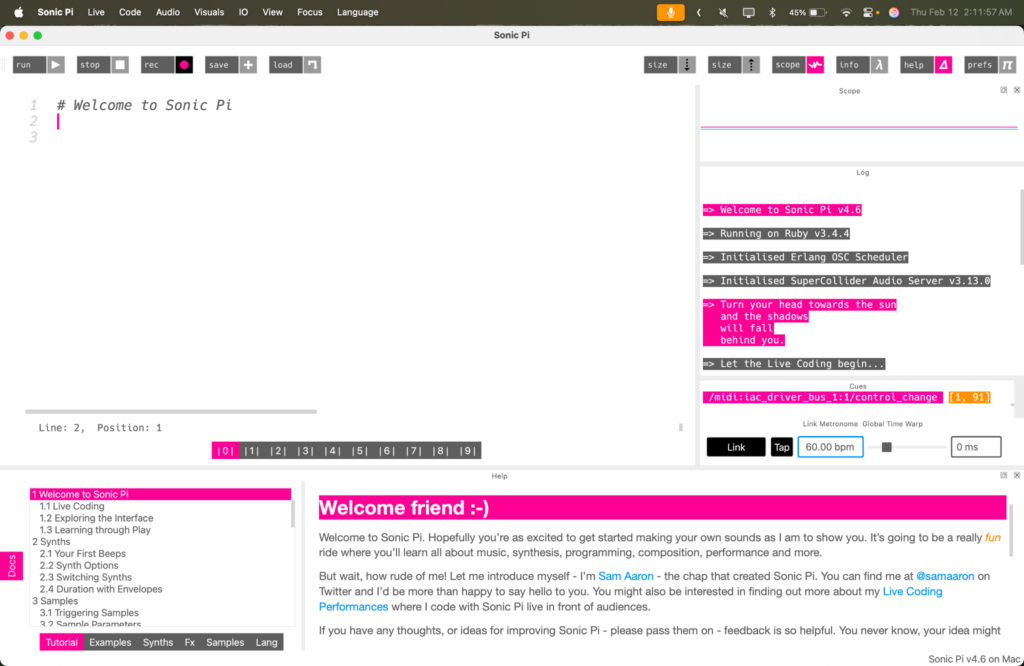
The Program runs similarly to how Tidal-Cycles does, where you type code and evaluate it. However, one core difference between Sonic Pi and Tidal-Cycles, is, instead of evaluating line by line, each time you run the code, you run the whole code on the current document. Similarly to Tidal-Cycles though, it doesn’t generate any sound itself, but it utilizes SuperCollider for sound generation, albeit, having it built into the program when you download it.