What is Alda?
Alda is a text-based, open-source programming language designed for musicians to compose music in a text editor without needing complex graphical user interface (GUI) software.
The Alda music programming language was created by Dave Yarwood in 2012. Interestingly, he was a classically trained musician long before he was a competent programmer
Why Alda?
In contrast to working with complex GUI applications available at the time, Dave Yarwood found that programming pieces of music in a text editor is a pleasantly distraction-free experience.
How it Works
The process is beautifully simple:
- Write the notes in a text file using Alda’s syntax
- Run the file through the Alda interpreter
- Hear the music come to life
Key Features
Alda uses the General MIDI sound set — giving you access to over 100 instruments.
Basic Syntax
- Pitch: The letter represents the pitch.
cis C,dis D,eis E, and so on. - Duration: The number indicates how long it lasts in beats. In Alda, smaller numbers mean longer notes—it’s backwards from how we normally think!
- Octave: The octave number tells Alda how high or low to play.
c4is middle C,c5is one octave higher,c3is one octave lower.
Handy Shortcuts
>moves you up one octave<moves you down one octave
Chords and Rests
- The forward slash
/is your chord maker. It tells Alda to play notes at the exact same time. - Rests use
rinstead of a note name. The same duration rules apply.
Visual Aid
The vertical bar | does absolutely nothing to the sound. It’s just there to help you read the music more easily.
Demo
Here is the short demo I made using Alda!
It is a fairly simple Piano composition
Code
This is the code that I ran for the Demo Video !!
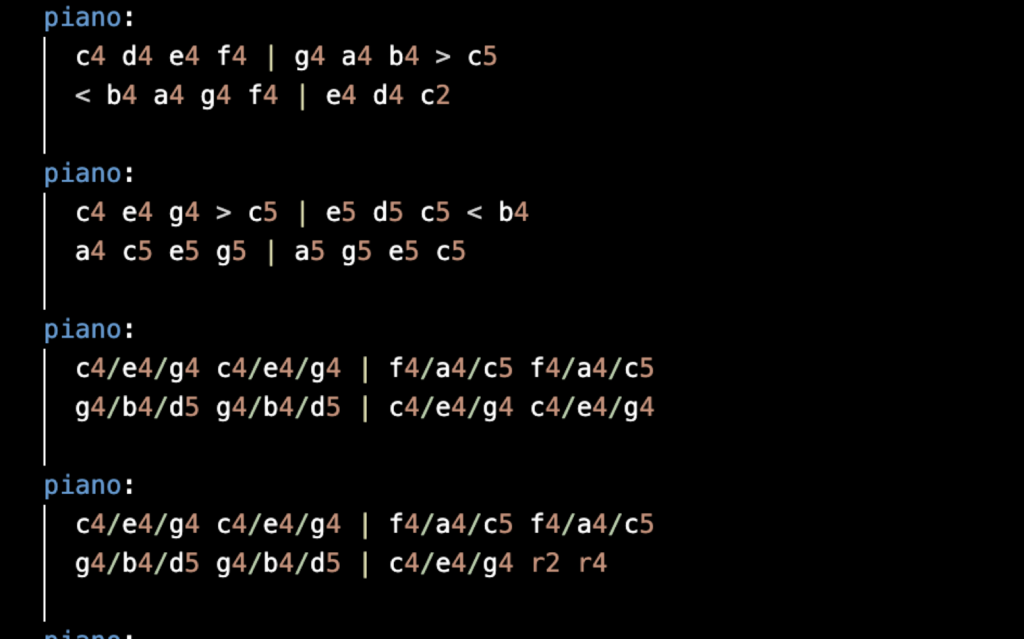
piano:
  c4 d4 e4 f4 | g4 a4 b4 > c5
  < b4 a4 g4 f4 | e4 d4 c2

piano:
  c4 e4 g4 > c5 | e5 d5 c5 < b4
  a4 c5 e5 g5 | a5 g5 e5 c5

piano:
  c4/e4/g4 c4/e4/g4 | f4/a4/c5 f4/a4/c5
  g4/b4/d5 g4/b4/d5 | c4/e4/g4 c4/e4/g4

piano:
  c4/e4/g4 c4/e4/g4 | f4/a4/c5 f4/a4/c5
  g4/b4/d5 g4/b4/d5 | c4/e4/g4 r2 r4

piano:
  c4 e4 g4 > c5 | < b4 g4 e4 c4
  c4 e4 g4 > c5 | < b4 g4 e4 c2 r2

piano:
  c4 e4 g4 > c5 | e5 d5 c5 < b4
  a4 c5 e5 g5 | a5 g5 e5 c5

piano:
  c4/e4/g4 c4/e4/g4 | f4/a4/c5 f4/a4/c5
  g4/b4/d5 g4/b4/d5 | c4/e4/g4 c4/e4/g4

piano:
  c4/e4/g4 c4/e4/g4 | f4/a4/c5 f4/a4/c5
  g4/b4/d5 g4/b4/d5 | c4/e4/g4 c4/e4/g4

piano:
  c4 d4 e4 f4 | g4 a4 b4 > c5
  < b4 a4 g4 f4 | e4 d4 c2

piano:
  c4 e4 g4 > c5 | < b4 g4 e4 c4
  c4 e4 g4 > c5 | < b4 g4 e4 c2 r2

piano:
  c4/e4/g4 c4/e4/g4 c4/e4/g4 c4/e4/g4 | f4/a4/c5 f4/a4/c5 f4/a4/c5 f4/a4/c5
  g4/b4/d5 g4/b4/d5 g4/b4/d5 g4/b4/d5 | c4/e4/g4 c4/e4/g4 c4/e4/g4 c4/e4/g4 r2 r2

piano:
  c4/e4/g4 r2 | r1

piano:
  c4 r2 | r1
Alda represents a beautiful intersection between programming and musicianship—proof that sometimes the simplest tools can inspire the most creative work.
Thank You!!!